Studying Star Wars: The Friday Brief
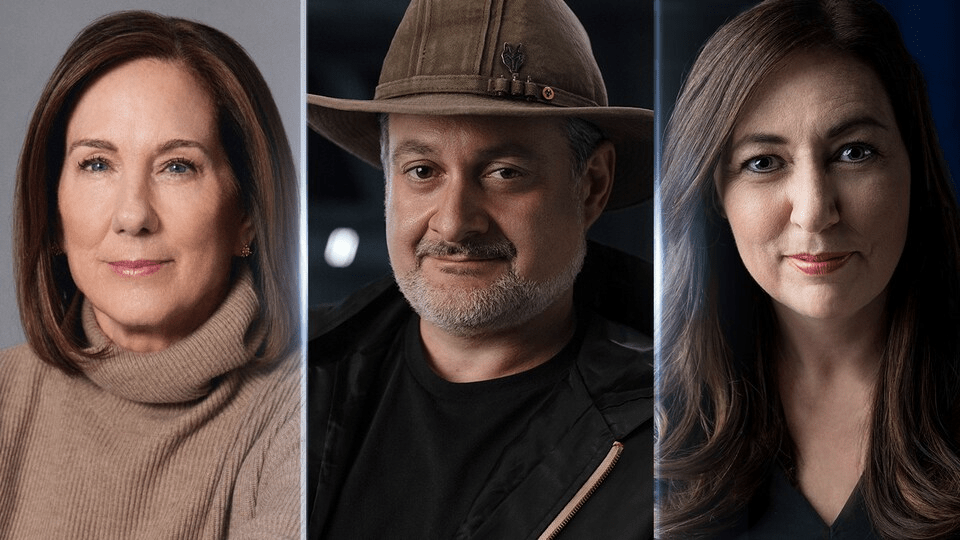
This week marked a significant institutional moment for Lucasfilm, one that arrived not with a teaser trailer or a casting announcement, but with a change at the very top of the organization. After more than a decade as president, Kathleen Kennedy has stepped down from the role. In her place, Dave Filoni has been named President and Chief Creative Officer, with Lynwen Brennan serving as Co-President.
The announcement, published directly by Lucasfilm, was notably restrained in tone—measured, forward-looking, and focused on continuity. That restraint is instructive. It signals that this transition is not intended as a rupture, but as an evolution in how one of the world’s most closely watched media franchises organizes creative authority and corporate leadership.
This week’s Friday Brief looks at what happened, why it matters, and what signals it sends—not as a fan reaction, but as media business reporting grounded in institutional context.
What Happened
The core facts are straightforward.
Kathleen Kennedy, who has led Lucasfilm since 2012 following its acquisition by Disney, is stepping down as president. Dave Filoni will assume the role of President and Chief Creative Officer, overseeing creative direction across the company, while Brennan will act as Co-President, focusing on operational leadership.
This structure formalizes a division that has, in practice, already existed: creative stewardship on one side, corporate operations on the other. What is new is the explicit elevation of creative leadership to the top executive tier.
There is no language in the announcement suggesting a philosophical break, a “course correction,” or a reaction to audience sentiment. Instead, the messaging emphasizes stability, trust, and long-term stewardship.
Why This Matters
Star Wars is no longer simply a film series or even a transmedia storyworld. It is a mature, multi-platform intellectual property with interconnected pipelines across film, streaming, animation, publishing, licensing, and experiential media. Leadership decisions at Lucasfilm therefore function less like auteur handoffs and more like governance changes at a legacy media institution.
By naming Filoni as President and Chief Creative Officer, Lucasfilm is making a clear structural statement: creative coherence is not a downstream concern but a top-level responsibility.
This matters because modern franchises are often strained by scale. As output increases across platforms, the risk is not simply inconsistency of tone or canon, but fragmentation of vision. Embedding creative authority at the presidential level is one way organizations attempt to manage that risk.
Importantly, this is not unprecedented in media history. Other long-running franchises have experimented—sometimes successfully, sometimes not—with different models of creative centralization. What makes the Lucasfilm case distinctive is how explicitly it ties executive authority to deep internal continuity.
Continuity, Not Revolution
Dave Filoni’s ascent is often framed externally as a symbolic shift, but institutionally it represents continuity.
Filoni’s career has unfolded almost entirely inside Lucasfilm. He worked closely with George Lucas during the development of Star Wars: The Clone Wars, where he helped expand the narrative architecture of the prequel era and demonstrated how animation could function as serious, canon-defining storytelling. That period was foundational, not only creatively, but pedagogically—Filoni learned how Lucas thought about myth, structure, and long-form narrative accumulation.
In the Disney era, Filoni became a bridge figure. He helped shepherd Lucasfilm animation forward while also moving into live-action development, most visibly through his collaboration with Jon Favreau on The Mandalorian. That series, positioned as a stylistic and production experiment, ultimately functioned as a proof of concept for Disney+ era Star Wars.
From an institutional perspective, Filoni is not an outsider brought in to “fix” the franchise. He is an internal figure whose authority has accumulated gradually through trust, apprenticeship, and demonstrated fluency in Star Wars’ narrative grammar.
Seen this way, the leadership change looks less like a pivot and more like a formal acknowledgment of how the company has already been operating.
Kathleen Kennedy’s Institutional Legacy
Any serious analysis of this transition must acknowledge Kennedy’s tenure without reducing it to cultural flashpoints or online discourse.
Kennedy oversaw Lucasfilm through one of the most complex periods in its history: the transition from creator-owned studio to subsidiary of a global entertainment conglomerate. Under her leadership, Lucasfilm relaunched Star Wars as a theatrical franchise, expanded it into streaming, rebuilt its animation slate, and navigated the pressures of operating a legacy property in a hyper-scrutinized media environment.
Her role was fundamentally institutional. She was tasked with building systems, managing risk, and translating a singular creative vision into a sustainable corporate structure. That work is often invisible when it succeeds and highly visible when it encounters friction.
The current transition does not erase that legacy. Instead, it suggests that the systems she helped build are now stable enough to support a different leadership configuration, one that places creative continuity more explicitly at the executive center.
What to Watch Going Forward
Rather than speculating about future films or character arcs, the more meaningful signals to watch are structural.
How will creative authority flow between film, streaming, and animation? Will Lucasfilm consolidate development pipelines further, or continue to experiment with format and scale? How will the balance between centralized canon stewardship and creative experimentation be managed under this new structure?
These questions are not fan hypotheticals; they are media governance questions. Their answers will emerge slowly, through hiring decisions, production slates, and the rhythm of releases, not through any single announcement.
A Teaching Note
For those studying Star Wars as a media institution, this leadership change offers a valuable case study. It illustrates how legacy franchises adapt organizational structures over time, how creative authority is formalized, and how companies attempt to preserve coherence at scale.
This moment will be revisited in future Studying Star Wars work, not as a turning point defined by reaction, but as part of a longer arc in the life of a modern media franchise.
For now, it is best understood not as an ending or a beginning, but as a continuation, one that reveals how Lucasfilm sees its own future.
Studying Star Wars: The Friday Brief runs weekly, examining Star Wars through the lenses of media, culture, and institutional practice.
 Studying Star Wars
Leave a comment